Long-Term Care is Essential to Aging Well in Canada
Across Canada, families are having increasingly complex conversations about aging. A parent needs more support. A spouse is living with dementia. A Veteran requires specialized care. A family caregiver needs a break.
These conversations are deeply personal, but they are also part of a much larger national reality. Canada's population of people age 85+ is expected to double by 2040 and because we're living longer the healthcare needs of our Veterans and Seniors are becoming more complex. Meeting those needs will require a stronger understanding of the role long-term care plays, not only as a place where people live, but as an essential part of the health system.
Long-term care is a core part of Ontario's healthcare continuum. It provides 24/7 nursing care, specialized supports and a home-like environment for seniors and others whose complex health and daily living needs can no longer be safely met at home or in the community. At its best, long-term care brings together clinical expertise, interdisciplinary teams, family partnership, quality improvement and practical research. It supports people with increasingly complex care needs while helping them maintain dignity, connection and quality of life.
Perley Health's newly published 2026 Community Impact Report shows how this work is taking shape.
One example is SeeMe®: Understanding frailty together, our framework for meaningful conversations among residents, families and care teams about goals of care. SeeMe® supports better planning and helps ensure decisions reflect what matters most to each senior. Through the Centre of Excellence in Frailty-Informed Care™, SeeMe® is now being implemented in other long-term care homes across Ontario.
The Centre of Excellence is funded by the Perley Health Foundation, whose donors help make practical research, evaluation and knowledge sharing possible. This is one of the ways Perley Health contributes beyond our own campus, helping to advance better care for older adults across the sector.
Long-term care also depends on the skill, compassion and consistency of the people who provide care every day. Personal Support Workers (PSWs) are central to resident quality of life. Through their close daily relationships with residents, PSWs understand each person's routines, preferences and needs, helping to provide care that is responsive, dignified and deeply personal. Perley Health also helps build this clinical expertise through its Living Classroom, developed in partnership with Algonquin College, which provides practical training in where PSW and nursing students learn alongside residents, families, staff and volunteers.*
Supporting the long-term care workforce is equally important. Our Community Impact Report highlights an innovative peer support program designed to help new nurses succeed. New hires are paired with experienced colleagues during their first six weeks, helping them build confidence, competence and connection in the unique environment of long-term care.
Quality improvement is another essential part of long-term care's contribution. Perley Health's 2026 Quality and Safety Report showed positive results across several key indicators, including falls, pain and pressure ulcers. In one initiative, Perley Health used CIHI data to strengthen wound assessment, prevention and staff training, helping reduce pressure ulcer rates from about 6 percent to consistently below 1 percent. These outcomes reflect the steady work of our care teams to improve practice, measure results and share what works.
As demand grows, capacity must grow too. Perley Health plans to add 120 long-term care spaces, bringing our total long-term care capacity to 570 beds. We expect to welcome residents into these new spaces in late 2029, helping to meet the growing need for specialized care.
Long-term care remains at the centre of Perley Health's work, but our clinical expertise also allows us to support Veterans, seniors and families in broader ways. Programs such as Living Well at Home™, including Respite House and the Adult Day Program, the Care Clinic, Senior Living and the Active Seniors and Veterans Living Centre extend that expertise into the community.
Canada needs a broader conversation about aging, one that recognizes long-term care as a vital part of the solution. Long-term care is where complex clinical needs, personal relationships, family support, research and quality improvement come together. It is not separate from the future of healthcare in Canada. It is central to it.
Read Perley Health's 2026 Community Impact Report at PerleyHealth.ca/community-report.
*We gratefully acknowledge our ongoing partnership with Algonquin College and the generous funding for this initiative by the Government of Ontario, led by the RIA, through the Ontario CLRI, in collaboration with CESBA.
By Rachel de Kemp, Vice-President, Nursing, Perley Health
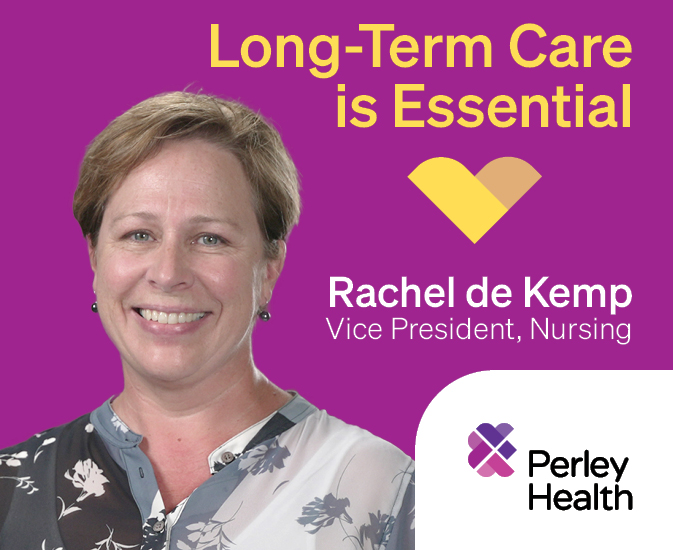
"Long-term care is a core part of Ontario's healthcare continuum." - Rachel de Kemp, Vice-President, Nursing, Perley Health