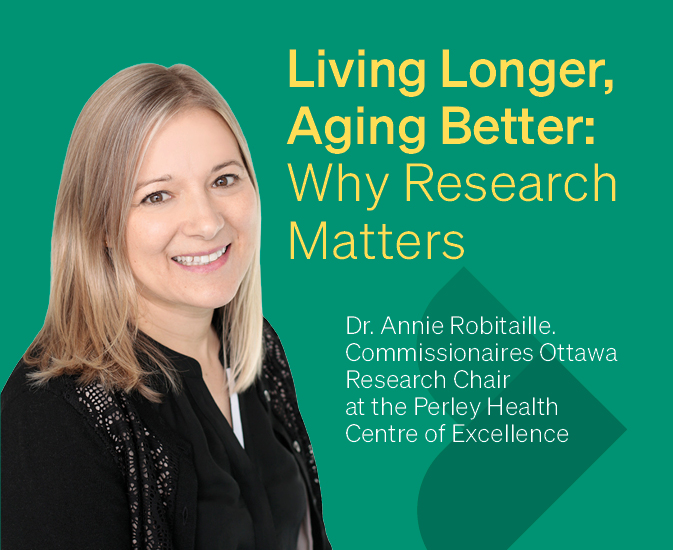
Living Longer, Aging Better: Why Research Matters
Canadians are living longer, and the number of older adults is growing. This achievement also presents an urgent question for health systems, researchers and policymakers: how can Canada support more people to age well while responding to increasingly complex care needs?
The answer cannot rest on capacity alone. More beds, programs and services will be needed, but expansion without evidence risks reproducing approaches that do not fully reflect what older adults, families, caregivers or care teams need. Canada must build a stronger connection between research and the places where aging and care are experienced every day.
As Commissionaires Ottawa Research Chair at the Perley Health Centre of Excellence in Frailty-Informed Care™, I see the value of that connection firsthand. The Centre of Excellence brings researchers, healthcare professionals and people with lived experience together to identify important questions, test ideas in real care environments and share what is learned with others. This work is made possible by donors to the Perley Health Foundation, whose support helps turn research and promising ideas into practical tools and better care for Veterans and Seniors.
Research in real care environments
The Centre of Excellence is embedded within Perley Health, a community that includes approximately 450 long-term care residents, many of them Veterans, and about 200 Seniors living in independent apartments. This setting creates opportunities to study aging across different stages and circumstances while keeping research grounded in daily life.
Perley Health has committed to responsibly doubling the number of Veterans and Seniors it serves by 2035. Achieving that goal while maintaining excellent care will require insight into how needs are changing, which practices produce meaningful benefits and how promising approaches can be implemented at scale.
The living lab approach helps generate that insight. Residents, tenants, families, caregivers and staff can become partners in identifying questions, shaping studies and testing solutions. Their involvement improves the relevance of the research and helps researchers understand the practical conditions that influence whether an idea succeeds. A promising intervention must work not only in theory, but in a resident's room, during a care transition, within a busy clinical team or in a family conversation about difficult decisions.
From evidence to practice
Research has its greatest value when findings can be applied. For that reason, the work of the Centre of Excellence connects applied research with education, evaluation and knowledge translation. Evidence can become a field guide, training program, webinar, clinical resource or framework that another organization can adapt to its own circumstances.
SeeMe® is one example. This approach supports residents, families and care teams in making informed decisions about goals of care. Following an evaluation, the Centre of Excellence developed e-modules that make the learning available to long-term care professionals beyond Perley Health.
Workforce research offers another example. The Centre of Excellence evaluated Perley Health's orientation peer-support program for newly hired nurses and developed a practical field guide for other homes. Supporting nurses as they build confidence, connect with colleagues and adapt to long-term care can strengthen both workforce stability and resident care.
Research is also informing intergenerational programming at the newly opened Andrew Fleck Children's Services Intergenerational Early Learning Centre at Perley Health. The research will examine how meaningful relationships between children and older adults can be supported and what can be learned for similar programs elsewhere.
Veterans' health and aging
The need for practical, collaborative research is especially important for aging Veterans. Their experiences, service histories, family relationships and transitions through different systems of care can shape their needs in later life. Effective research must include Veterans and the people who support them, and it must account for the realities of accessing services in communities across Canada.
A project funded by Veterans Affairs Canada is doing exactly that. The Centre of Excellence is engaging aging Veterans, families, caregivers, researchers and service organizations to identify gaps in information about support, services and care transitions. Their input will guide the development of a comprehensive bilingual online resource. The process matters as much as the eventual platform: the people expected to use the resource are helping determine what it should contain and how it should work.
Partnerships with organizations such as the Canadian Institute for Military and Veteran Health Research also help connect questions arising in care environments with expertise and research capacity across the country. These relationships enable knowledge to move in both directions, between research and practice and between local experience and national priorities.
Building a stronger research ecosystem
The Centre of Excellence is now involved in more than 20 research projects and has contributed to 50 publications between 2018 and 2026. These figures demonstrate growing capacity, but the more important measure is whether the work changes practice, supports better decisions and improves the experience of aging.
Canada needs research environments where academics, healthcare professionals, policymakers and people with lived experience can work on shared problems. It also needs reliable ways to translate findings into usable knowledge and to share that knowledge across organizations and jurisdictions.
Our aging population creates pressure, but it also gives Canada an opportunity to improve how care is designed and delivered. When research is connected to daily life, informed by the people most affected and translated into practical action, it can help more Veterans and Seniors age with dignity, purpose and connection.
By Dr. Annie Robitaille, Commissionaires Ottawa Research Chair at the Perley Health Centre of Excellence in Frailty-Informed Care™
The Centre of Excellence is embedded within Perley Health, a community that includes approximately 450 long-term care residents, many of them Veterans, and about 200 Seniors living in independent apartments. This setting creates opportunities to study aging across different stages and circumstances while keeping research grounded in daily life.