People of Perley - Samantha Hallgren
Samantha Hallgren celebrates her CHPCN certification, discusses the most important factors for providing excellent palliative care, and shares why she's still not done learning.
Like most mothers, Samantha Hallgren is committed to attending all of her boys' hockey games. Unlike most mothers, last year Sam spent most of those hockey games toque on, mask up, and hunkered down on ice-cold bleachers, studying for what would end up being the hardest exam of her life.
Luckily, her hard work and evenings spent in a chilled arena, with one eye on the ice, and one on her notes paid off. Last November, Sam completed the Certified Hospice and Palliative Nurse [CHPCN] certification exam, an incredibly difficult assessment that takes four hours to write, months of preparation, and has a notoriously low passing rate. Participants need to have completed at least 1950 hospice and palliative nursing hours within five years before applying to take the exam, and score a minimum of 80% to pass.
The exam is built around 165 questions directly related to work performed by hospice and palliative nurses, and measures knowledge in eight specific areas of care: Person and Family-Centered Care; Pain Assessment and Management; Symptom Assessment and Management; Care in the Final Days; Loss, Grief, and Bereavement; Collaborative Practice; Education, Professional Development and Advocacy; and Ethics and Legal Issues. Sam is a pioneer at Perley Health; the first staff member to receive CHPCN certification. “It's something I've wanted to do for a really long time,” Sam says. “I received my Gerontological Nursing Certification from the Canadian Nurses Association back in 2014, but I've always wanted to do the palliative one, even knowing how hard it is.”
Before joining Perley Health (in 2011, and returning in 2015 after a brief placement in Petawawa with her family) Sam started her career at the Glebe Centre. She learned early on that she wanted to do what she could to change the way that end-of-life care was typically administered in health care.
“I would get new referrals for high-risk residents who were really frail, and within short periods of time would pass away. I would care for them when they were considered high-risk, and then have to discharge them once that was no longer the case. I had a very difficult time discharging someone who I cared for, who was now dying when I was equipped to continue care. I create relationships with these residents and their families, and it just didn't make sense to me.
I began asking to follow them and assist with their end-of-life care, and I was completely supported by Perley to do this.”
When Sam started her nursing career 25 years ago, she knew quickly that palliative care was her calling. “I've always been super passionate about palliative care, I've always come by it very naturally, even when I was young.” She shares memories of being 18, at the beginning of her term at nursing school, spending her summers working in her community with residents in their homes.
“The first lady I ever worked with who was at end of life had three children all under the age of five. She wouldn't let anyone in her room, ever, but she allowed me in and to care for her. I was still in nursing school, and she allowed me to care for her in a way that she would not let anyone else. I am [not] really sure why she let me in, maybe because I wasn't trying to make her feel better, but just tried to connect [with her]. I could sit with her in the complete darkness of her room and talk about things that were important to her, and not just discuss things that were medical-related—sometimes we just need to be relatable, be still, be silent, be mindful. That has always stayed with me, and was one of the experiences that inspired me to really focus on palliative care.”
As the decision to write the CHPCN exam is a full commitment, the preparation it requires could be considered a part-time job. The difficulty level of the test, however, and the requirements are justified; it demands that the practitioner has both the knowledge and the experience to earn those letters after their name. What really puts the exam's difficulty in perspective are the countless message boards, support groups, and peer advice channels that exist for those even considering writing the challenging test (all professionals at various stages in their career – some 20+ years – advising to not take their preparation lightly).
Since there is so much material to cover, Sam shares that it was crucial to go back and study areas of medicine she hasn't had to revisit in years (including pediatrics). It is because of this that Sam spent most of her time (an additional 7-10 hours a week outside of her full-time job and caring for her family of five) preparing. “I did every single course known to mankind until I couldn't do any more palliative courses, I took no shortcuts,” Sam laughs.
Sam also credits the support she received from the rest of her team, Dr. Benoît Robert, Chief Medical Officer, and Jen Plant, Director, Clinical Practice, as essential influences in her success. Both Dr. Robert and Jen have been mentors and supporters throughout, particularly in the application process, and encouraged her to participate in the Palliative Medical Intensives program offered by Victoria Hospice in Vancouver. Sam was supported in her training financially by the Perley Health Professional Development Fund, which encourages the professional development of staff and is managed through Perley Health. This funding is made possible thanks to the generous contributions of donors to the Perley Health Foundation.
“I really feel like I've spent the last 20+ years preparing for this exam,” says Sam. “I was already doing all of the work, and I was taking online classes, I was helping co-lead and support the quality improvement team, and I was doing in-house consults with and in support of other nurses.”
Smart goals fill a wall in Sam's office- a collection of learning objectives she wants to focus on that she updates regularly. She shares that for a while now, right next to her sign reading, ‘CHPCN exam- maybe?' her board has had the goal of incorporating more trauma-informed care into her team's palliative process.
Sam acknowledges that this is a bit of a hurdle in the sector, as residents are becoming more frail, and often have multiple medical diagnoses and a history of trauma.
“Our residents are living longer, and their trauma is real and difficult. I have a very minimal level of education surrounding trauma-informed care, but I'm learning. It's incredibly important to factor in and incorporate trauma-informed care into end-of-life practices. The struggle is, and what has been clear, is that all of our staff are dedicated to caring for our residents and residents at end of life and have this wonderfully positive feeling from that, but at the same time most of the staff are terrified to talk about death and dying. It's so profound to see PSWs who are so dedicated to their profession and person-centered care, also have that fear… to be nervous to talk to families and terrified to say the wrong things. The care that they provide is remarkable, but often we see that staff are nervous to provide that care in the presence of the families. I'm really working on building that capacity within the team.”
Sam was one of the first nurses at Perley Health trained in the Centre of Excellence's SeeMe® program, which works with residents, their loved ones, and Perley Health staff to integrate frailty into care and treatment plans. She was also one of the key trainers for the program who supported building knowledge and confidence for the rest of the team.
The goal of SeeMe® has been ensuring that the final chapter of a resident's life aligns with their goals—a major factor of success for palliative care nursing as well. Sam has been an integral part of the SeeMe® implementation, and the positive results the program evaluation produced. Sam acknowledges that (although it seems difficult to believe her) her learning still isn't done. In studying for the exam she was having to revisit areas that she doesn't normally practice every day (such as management of acute health events). She says it's this learning and enhancement of her abilities that make all the difference to her care, her team, and the residents she cares for.
“It was important to me to do this because even though it's something I'm already doing, care I'm already implementing every day, I really want to be able to say to those families, ‘Yes, I am a Geriatric Nurse, but I'm also a Palliative Care nurse.' And provide that reassurance. It's important to the families, and our teams, and I knew that our residents would benefit tenfold.”
Sam shares that two additional goals she has added to her wall are learning more about Indigenous practices for end-of-life care, and sitting on the review board for the CHPCN exam to provide feedback related to her experience. And while Sam is sure to continue to post more goals to her wall, we are thrilled to help her celebrate one smart goal -perhaps her most daunting- that she can now remove and replace with her certificate.
Share Your Story
Be part of the People of Perley features by contacting the communications team at info@perleyhealth.ca
And the difference is YOU!
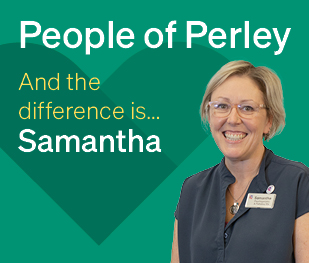
"I love working on an interprofessional team that seeks to offer the best possible care to our residents and families that supports dignity at end-of-life.” - Samantha Hallgren, Psychogeriatric & Palliative Care Registered Nurse